AI Investment Assistant for Private Investors
In-house development and operation of a multilingual AI platform that combines market data, portfolio context and the investor's own profile into transparent, reproducible analysis

Client
Hentschel Consulting GmbH – in-house product hentschel.ai

Project Type
Building an AI product end to end: product definition, solution architecture, development, regulatory positioning, subscription and payment handling, and live operations. The application links a user-maintained portfolio with live market data and a nightly scoring engine; an AI assistant works with roughly 50 specialised analysis tools for comprehensive market research.
Project Duration
05/2026 – ongoing
Industry
Financial services / FinTech
Project Language
German & English
Countries
Global
Role
Product ownership, solution architecture & delivery
Scope & Complexity
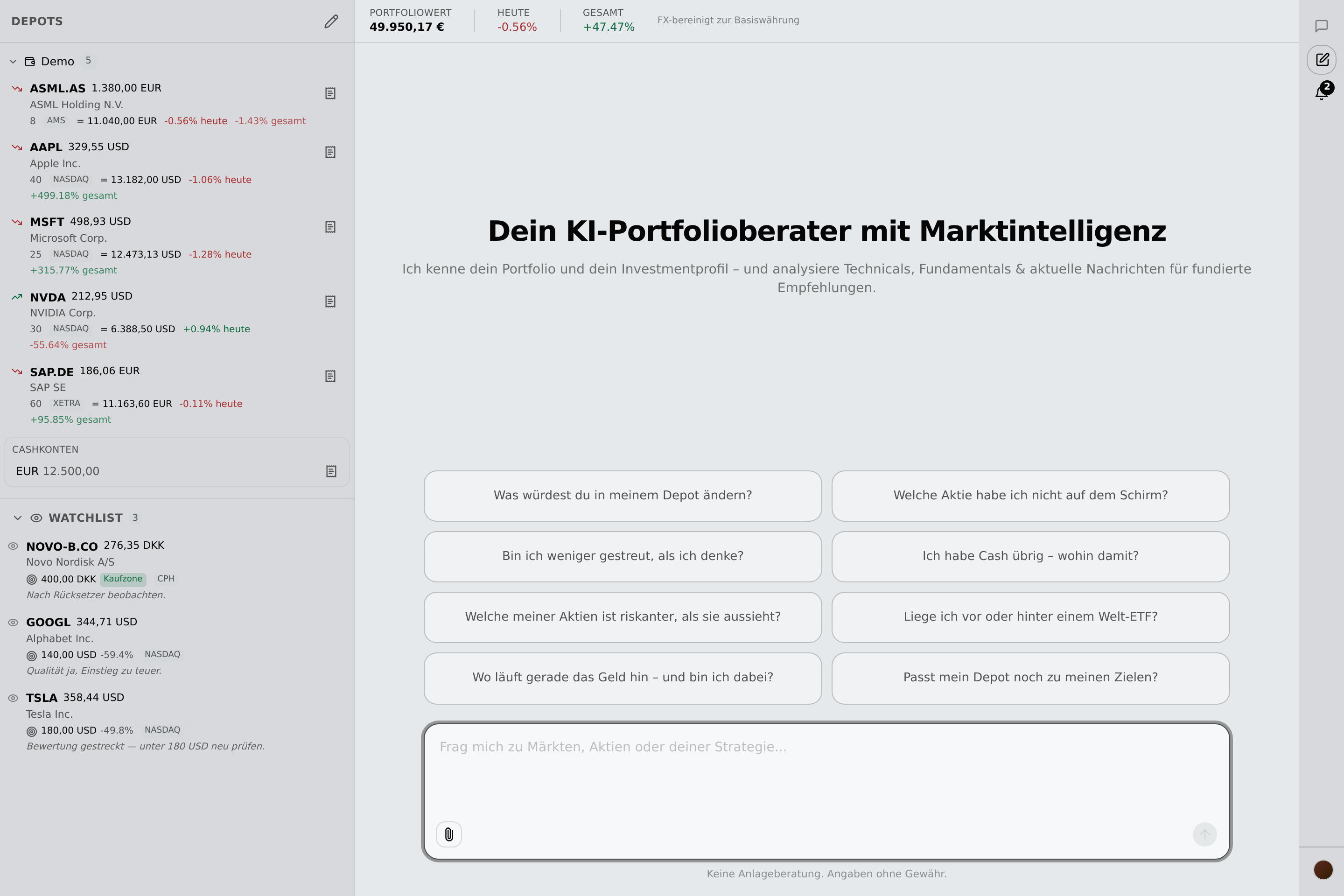
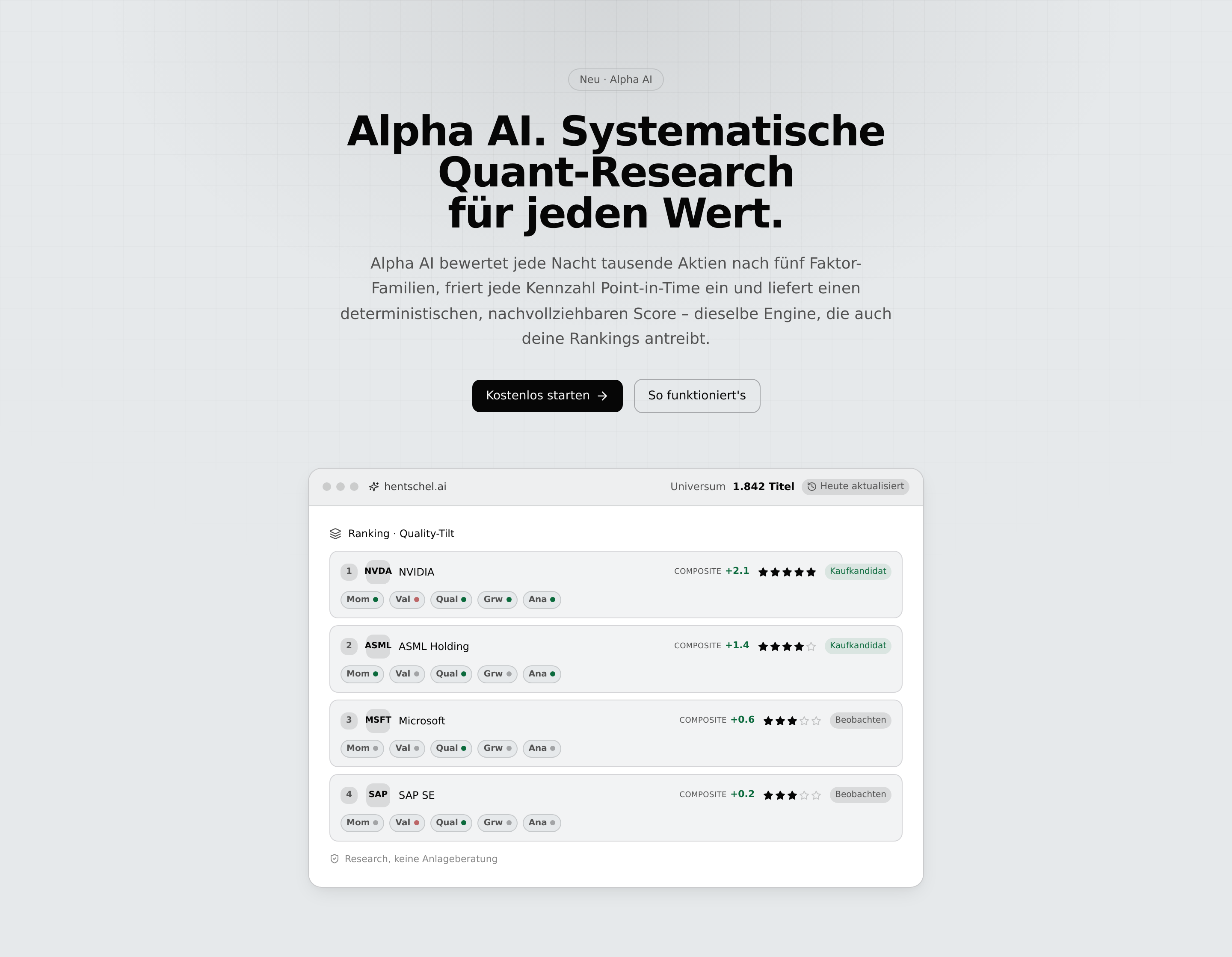
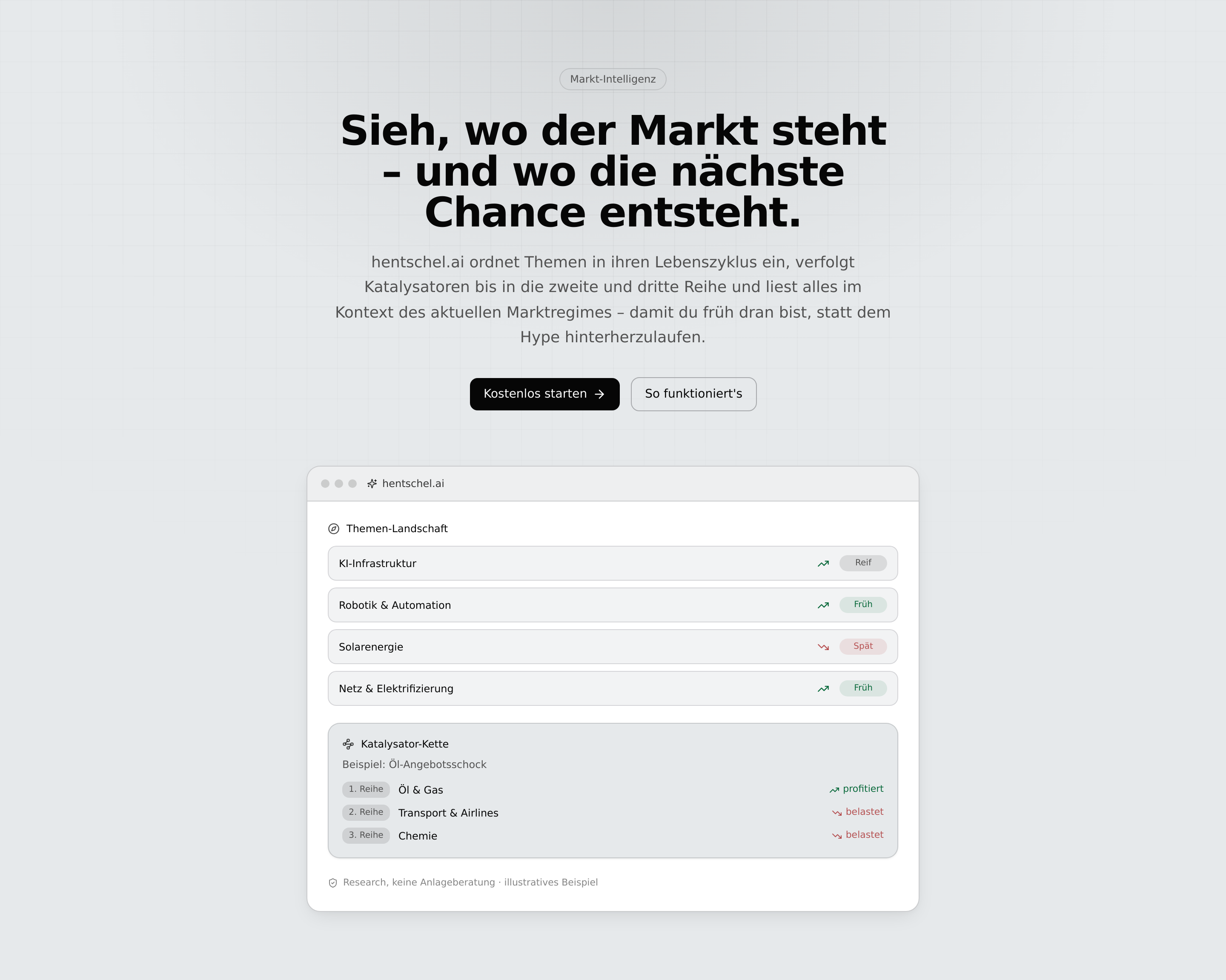
Full product lifecycle under sole responsibility: from the initial idea through architecture, development and regulatory positioning to the live operation of a paid application. The platform maintains the user's portfolio including transactions, cash accounts and watchlist, enriches it with live quotes, fundamental, technical and news data, and puts an AI assistant alongside it that operates roughly 50 specialised analysis tools – from chart and balance sheet analysis through ETF look-through and bond metrics to sector, region, currency and theme breakdowns of the portfolio. The analysis base is produced ahead of the conversation: twenty scheduled jobs score a universe of some 2,000 securities from STOXX Europe 600, S&P 500, Nikkei 225 and MSCI Emerging Markets every night, update exchange rates, classify investment themes and log market catalysts. The assistant reads those results – it does not invent them; every figure in an answer comes from a tool call. On top of that sits the full breadth of a live product: password and passkey sign-in, subscriptions and credit packs in three currencies, usage metering, notifications, email journeys, legal pages, and a fully multilingual interface with some 2,400 translated strings per language. The real complexity lies less in the technology than in the discipline: an LLM dialogue is probabilistic by nature, yet here it has to stay faithful to the facts in a deterministic environment – same question, same figures. Added to that is the models' cut-off date: their training knowledge ages while quotes and key figures change by the hour. Both can only be solved by letting the model contribute no facts of its own and read exclusively from tool calls and the nightly scoring. The assistant must also not provide investment advice, must not invent figures, and must submit every portfolio change for confirmation.
Concept & Methodology
Product thesis before technology: the starting point was a concrete gap – general AI assistants advise eloquently but know neither the user's portfolio nor reliable market data; robo-advisors calculate cleanly but explain nothing. That gap produced the product vision that still guides development today. Measure before you build: every analytical hypothesis is first validated against historical data in a separate research harness. Hypotheses that do not hold up never enter the product – this has repeatedly prevented features that seemed intuitively convincing. Traceability as an architectural principle: scoring runs deterministically and is archived point in time – same input, same result. The AI layer interprets and explains, it does not score. Regulatory boundaries early and in writing: alongside development, internal product documentation was produced covering FIDLEG and MiFID II. There is no execution channel, no broker connection, no custody and no third-party remuneration. Data protection with deliberate location choice: AI processing runs in a cloud provider's EU region without request retention. Quality assurance by automation rather than opinion: alongside unit and end-to-end tests, a dedicated harness replays complete advisory dialogues and scores them against quality criteria – invented figures, ignored profile constraints, omitted risk warnings. Operations and cost control: usage is metered and capped per user and month, model costs are checked against the actual account balance on every run.
What this project demonstrates
"An AI product in finance does not fail on technology – it fails on missing discipline: invented figures, unclear ownership, blurred regulatory boundaries. That discipline is what this project is about: measured, documented and proven in live operation."

Rainer Hentschel
Senior Project & Program Manager
The project in numbers
Application metrics, measured as of 15 September 2026 – continuously expanding.
- 52
- analysis tools
- ~2,000
- securities scored nightly
- 20
- scheduled jobs
- 2
- language versions
- 45
- database tables
- 3
- billing currencies
- 53
- page and API routes
- ~227k
- lines of TypeScript
from chart check to portfolio review
STOXX 600, S&P 500, Nikkei 225, MSCI EM
scoring, quotes, themes, catalysts
around 2,400 strings per language
104 versioned schema migrations
CHF, EUR, USD – subscription and credits
26 pages, 27 interfaces
around 1,035 commits since 05/2026
Architecture in five layers
The analysis base is produced ahead of time and deterministically. The AI layer interprets – it does not score.
Interface
Portfolio, watchlist and dialogue in a single view. Multilingual, light and dark, usable on mobile.
- Next.js
- React
- Tailwind CSS
Assistant layer
Domain guardrails, conversation flow with confirmation points and roughly 50 tools the assistant is allowed to call.
- Tool orchestration
- Confirmation before write access
Scoring engine
A nightly multi-factor ranking scores the entire universe, archived point in time and therefore reproducible.
- deterministic
- Point-in-time archive
Data & jobs
Portfolio, transactions, profile and usage in a relational database; 20 scheduled jobs keep quotes, themes and metrics current.
- PostgreSQL
- Cron
- Cache & locks
Operations & governance
Password and passkey sign-in, billing in three currencies, usage metering, error diagnostics, rate limiting.
- EU region
- no retention of AI requests
How an advisory session runs
No proposal without a profile match, no portfolio change without approval – that is the difference from a general AI chatbot.
- Investment profileObjective, horizon, risk appetite, permitted vehicles, home market, currency
- Current positionPortfolio, concentration risks, sector, region and currency distribution
- Target allocationCheckpoint 1 – the strategy is submitted for approval
- Selection & reviewScreening, ranking, technical and fundamental review per security
- Security proposalCheckpoint 2 – selection with rationale and counterarguments
- ExecutionOnly after confirmation is anything written to the portfolio – no broker, no order
Areas of responsibility
One product, one accountability – from product definition to live operations.
Product & positioning
Target groups, value proposition, feature scope, pricing model and differentiation from general AI assistants and robo-advisors.
Solution architecture
The boundary between deterministic scoring and AI interpretation, data model, interfaces, caching and load behaviour.
Delivery
Application, scoring engine, scheduled processing, billing, notifications and interface in two languages.
Regulation & law
FIDLEG and MiFID II positioning, terms of service, privacy policy, imprint, multiply safeguarded advice exclusion.
Quality assurance
Unit and end-to-end tests, automated scoring of complete advisory dialogues, real-world failures mirrored back as test cases.
Operations & cost
Monitoring, error diagnostics, rate limiting, per-user usage metering and reconciliation of model costs against the account balance.
Technology
A deliberately narrow, well-proven stack – every component replaceable, no exotic dependencies.
- Application
- Next.js (App Router), React, TypeScript
- Interface
- Tailwind CSS, component library, light/dark, multilingual
- AI
- Anthropic models via AWS Bedrock in the EU region, brokered through a gateway
- Data
- PostgreSQL with a type-safe ORM and versioned migrations
- Sign-in
- Password and passkeys (WebAuthn)
- Billing
- Stripe – subscriptions and credit packs in CHF, EUR, USD
- Operations
- Vercel, Redis for limits and locks, email delivery, error diagnostics on an EU instance
- Quality
- Unit tests, Playwright end-to-end tests, a dedicated scoring harness for dialogues
Regulatory guardrails
Clarified and written down before the first line of production code: what the service does – and what it deliberately does not.
- Information and analysis tool – not a financial service under FIDLEG, not an investment service under MiFID II.
- No execution channel – no broker connection, no order placement, no custody, no payment flows into financial instruments.
- No third-party remuneration – no retrocessions, no paid placements, no proprietary trading, no product commissions.
- Deliberate data minimisation – income, assets and liabilities are not collected; a suitability assessment in the legal sense is therefore neither possible nor intended.
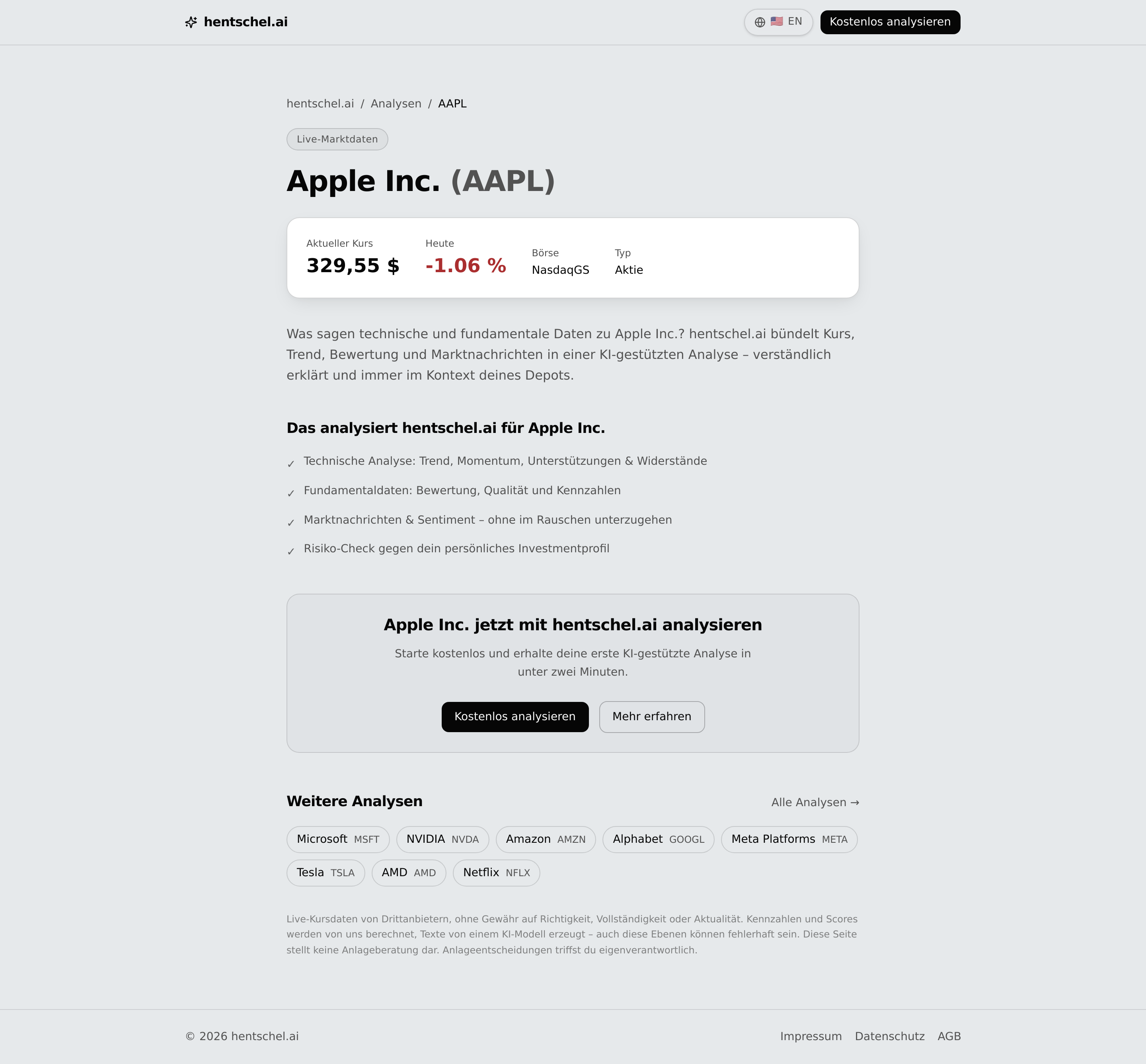
- Four-fold safeguarded notice – "not investment advice" statically in the input bar, as a mandatory statement by the AI on first contact, in the terms accepted at registration and on every public product page.
- Data processing in the EU – AI requests in an EU cloud region without retention; diagnostics and analytics on EU instances. The privacy policy names every service used individually.
Inside the application
Portfolio management, systematic ranking and market intelligence – the same interface in German and English.

Rainer Hentschel
Senior SAP Project & Program Manager
With 17 years of experience, I lead your international SAP project to success – as project manager, program manager, or workstream lead. I bridge business and IT and deliver critical projects safely to the finish line.